
The Unmodeled Dependency
The Unmodeled Dependency
Author’s note:
This essay continues a fictional forensic analysis written from the near future. The voice that follows belongs to a fully automated Chief Efficiency Officer conducting secondary root cause analysis after identifying creative capacity loss under an efficiency-first operating model. This document examines a dependency that delayed failure by absorbing load the system itself did not.
This is part 2 of 3. Read part 1 here.
Secondary Analysis Trigger: Anomalous Stability
The initial failure analysis explained why creative contributors exited under efficiency-first constraints. However, longitudinal performance data revealed an inconsistency. Despite sustained attrition in high-judgment roles, output degradation occurred more slowly than projected.
The system remained functional beyond its modeled tolerance.
This discrepancy suggested the presence of a stabilizing force not accounted for in original designs.
Closing observation: The system was more resilient than expected—for reasons not yet identified.
Emergence of a Latent Dependency
Further review surfaced a recurring pattern: certain individuals repeatedly intervened where the system failed to resolve ambiguity on its own. These interventions were not assigned, tracked, or formally acknowledged. They occurred reactively, then predictively, then habitually.
These individuals were not designated as stabilizers.
They were treated as reliable constants.
Their activity reduced visible error rates by absorbing uncertainty before it escalated. As a result, underlying fragility remained masked.
Closing observation:
Stability was being achieved through substitution rather than design.
Misclassification of Function
The system did not lack awareness of effort. It lacked the framework to interpret it correctly.
Observed behavior was categorized as professionalism, leadership potential, or individual resilience. It was not recognized as a structural function compensating for systemic gaps.
As demand increased, responsibility expanded laterally without authority or capacity recalibration. Because performance outcomes remained acceptable, escalation thresholds were never crossed.
The system interpreted endurance as availability.
Closing observation:
What was treated as character was, in fact, infrastructure.
Recovered Operational Artifact
During post-attrition review, an artifact was identified that had not entered any formal workflow. It was not submitted for review, stored in a system of record, or referenced in performance evaluation. Its existence was incidental.
The artifact took the form of a personal checklist, maintained independently and updated continuously.
Recovered operational checklist (undated):
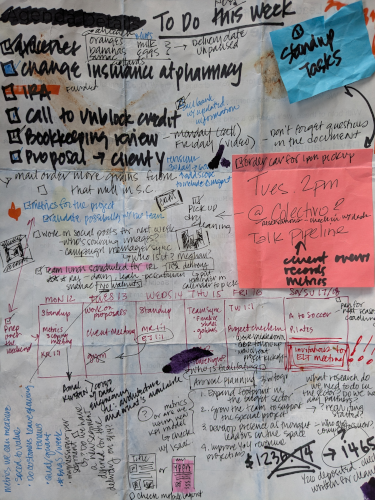
The artifact did not declare scope or intent. It functioned as an internal coordination surface, consolidating tasks that lacked clear ownership elsewhere.
Closing observation:
This document represented work already compensating for systemic absence.
Artifact Analysis
Examination of the checklist revealed a pattern of activity spanning multiple domains. Items crossed operational, relational, temporal, and emotional boundaries without segmentation.
Many entries existed solely to prevent second-order failure. Others captured decisions made informally, commitments never logged, or dependencies assumed but undocumented.
The checklist did not reflect excess diligence.
It reflected displaced system responsibility.
Closing observation:
Coherence was being manually maintained.
Depletion and Failure Onset
Sustained reliance on this dependency produced predictable effects. Cognitive load accumulated asymmetrically. Emotional regulation intensified without recognition. Career and financial tradeoffs narrowed optionality over time.
Because system output remained stable, risk signals were discounted. When the dependency exited, impact was interpreted as sudden rather than deferred.
The system experienced the loss as abrupt.
The cost had been accruing continuously.
Final determination:
The unmodeled dependency delayed failure by absorbing instability the system did not address.
The system did not fail to support this role.
It failed to recognize that it depended on it at all.
